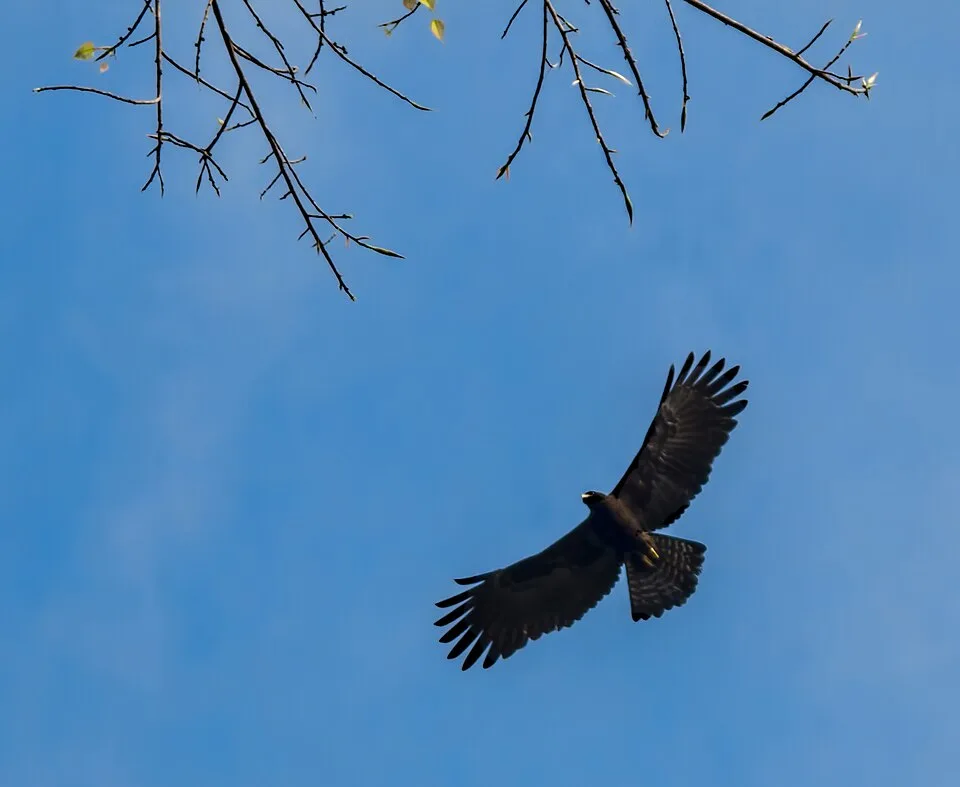
Long fingers above the canopy
A dark body, yellow feet and broad wings with long, separated feather tips produce a distinctive silhouette. The long tail opens into a fan. At close range, pale barring appears on the flight feathers and undertail. This forest eagle's slow, controlled flight is adapted to searching the treetops, making the wing shape as useful for identification as its colour. Its wings are unusually long and broad for such controlled manoeuvring. Widely separated wing tips help sustain slow flight above the canopy, while a broad gape and comparatively straight claws are associated with taking young birds from nests.
Sources & references · 2
Cornell Lab of Ornithology, eBird/Merlin · Black Eagle identificationLerner et al.; Zootaxa 4216(4):301–320 · Phylogeny and new taxonomy of the Booted Eagles (Accipitriformes: Aquilinae)A predator of treetop animals
Birds, their young and eggs form part of its prey, alongside small mammals. Slow flight allows close inspection of branches and nests. Feeding observations in Sri Lanka found squirrels and rats delivered to a chick, showing that local prey can differ from an egg-and-nestling diet alone. Those species-specific observations illustrate flexible feeding; they do not establish the proportions eaten on Borneo.
Sources & references · 2
Lerner et al.; Zootaxa 4216(4):301–320 · Phylogeny and new taxonomy of the Booted Eagles (Accipitriformes: Aquilinae)Samarawickrama et al.; Tigerpaper 38(2), FAO · Nesting of Black Eagle in Sri LankaForest slopes and tall nest trees
Forested hills and mountains are characteristic habitat, and Tawau bird surveys document its Borneo presence. Nests are platforms of branches in tall trees; parents supply the young with prey. It is globally Least Concern. Watching the canopy skyline from an open forest viewpoint offers a better chance to recognise its shape than searching for a nest beneath the trees.