Recognition
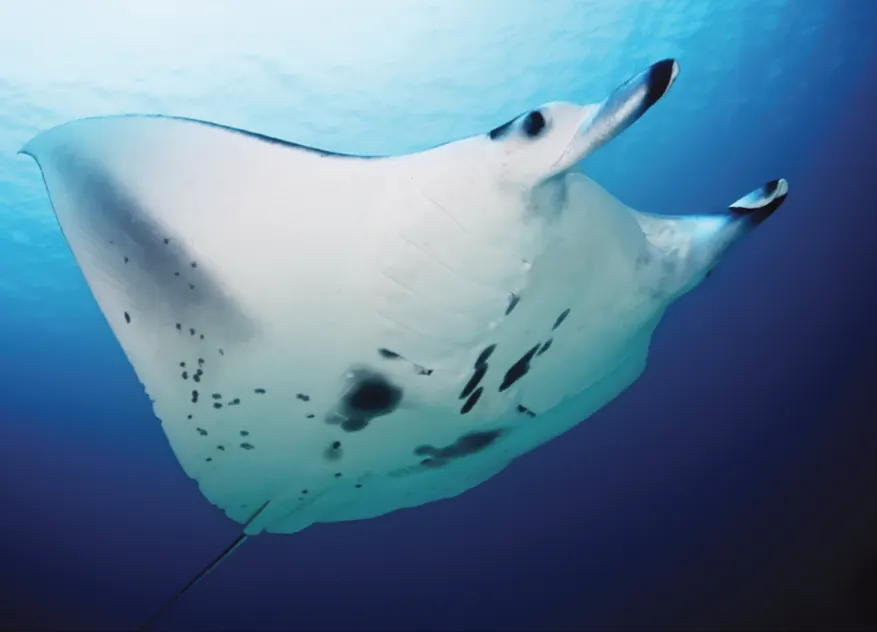
The broad disc is formed by enlarged pectoral fins. Beside the forward-facing mouth, the head fins can be rolled or extended, changing the outline while the manta swims. Patterns of spots on the underside allow researchers to recognize individuals across repeated encounters. That makes photographs of the belly valuable for understanding movements and repeated use of particular reefs, rather than simply recording an attractive silhouette.
Sources & references · 1
Species account or primary research · Peel et al. (2024), reef manta feeding and cleaning behaviour in SeychellesHabitat and Borneo range
Reef mantas use feeding areas and cleaning sites. Satellite-tracked animals at Sangalaki document the species in the Berau seascape of East Kalimantan. A cleaning site is a place where small cleaner animals service the ray’s body, often around a prominent reef structure. Feeding and cleaning fulfil different needs, so a manta’s habitat is a network of useful places rather than a single resting point.
Sources & references · 3
Fisheries 2025 10(2):66 · Staying Close to Home: Horizontal Movements of Satellite-Tracked Reef Manta RaysSpecies account or primary research · Manta Trust: mobulid behavioural ecologySpecies account or primary research · Peel et al. (2024), reef manta feeding and cleaning behaviour in SeychellesFood and ecological role
The head fins unfurl to channel plankton-rich water into the mouth. Food is filtered as water passes through the gill apparatus, making this large ray a consumer of tiny organisms. Feeding opportunities depend on where plankton accumulates. Studies of reef mantas show that feeding and cleaning can form repeated routines, connecting changing food patches with sites that animals revisit.
Sources & references · 2
Species account or primary research · Manta Trust: mobulid behavioural ecologySpecies account or primary research · Peel et al. (2024), reef manta feeding and cleaning behaviour in SeychellesReproduction
Courtship can take the form of males following a female in a swimming train. Fertilization is internal, and the mother gives birth to a live pup rather than laying an egg case on the reef. Cleaning sites can also be settings for courtship, linking reproductive behaviour with other repeated reef visits.