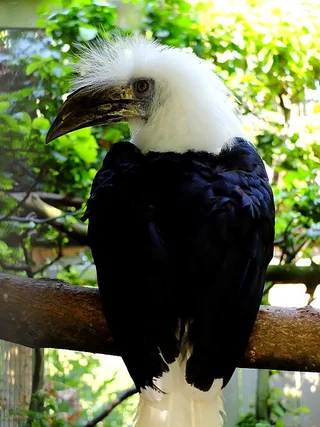
The white crest
A spiky white crest and long white tail create a striking outline. The male has a white neck and underside; the female's body is mostly black. Both have a dark bill with a small casque. Soft, paired or tripled cooing notes are characteristic. Its short flights through the canopy can make this large bird surprisingly inconspicuous. Young birds of both sexes initially resemble an adult male in their pale head, neck and underside. Their bill is dull greenish yellow and grey streaks mark the head and breast. Age therefore matters when interpreting the contrast between white and black body plumage.
Sources & references · 1
IUCN SSC Hornbill Specialist Group · White-crowned Hornbill accountHunting among branches and vines
Animal food is particularly important: insects, lizards, snakes and small vertebrate prey are taken, alongside fruit. The bird searches bark and vines and sometimes descends to the ground. It favours extensive rainforest and adjoining closed secondary forest, including riverine settings. A fruiting tree can attract it, but its feeding ecology reaches well beyond fruit alone.
Sources & references · 1
IUCN SSC Hornbill Specialist Group · White-crowned Hornbill accountA group supports the brood
The female closes herself into a tree hole, leaving a narrow feeding opening. The male and other group members, including young birds, help supply food to her and the chicks. She leaves when the chicks are ready to fly. The species is globally Endangered. Loss of mature rainforest affects both concealed hunting habitat and the hollow trees needed for breeding.