Recognition
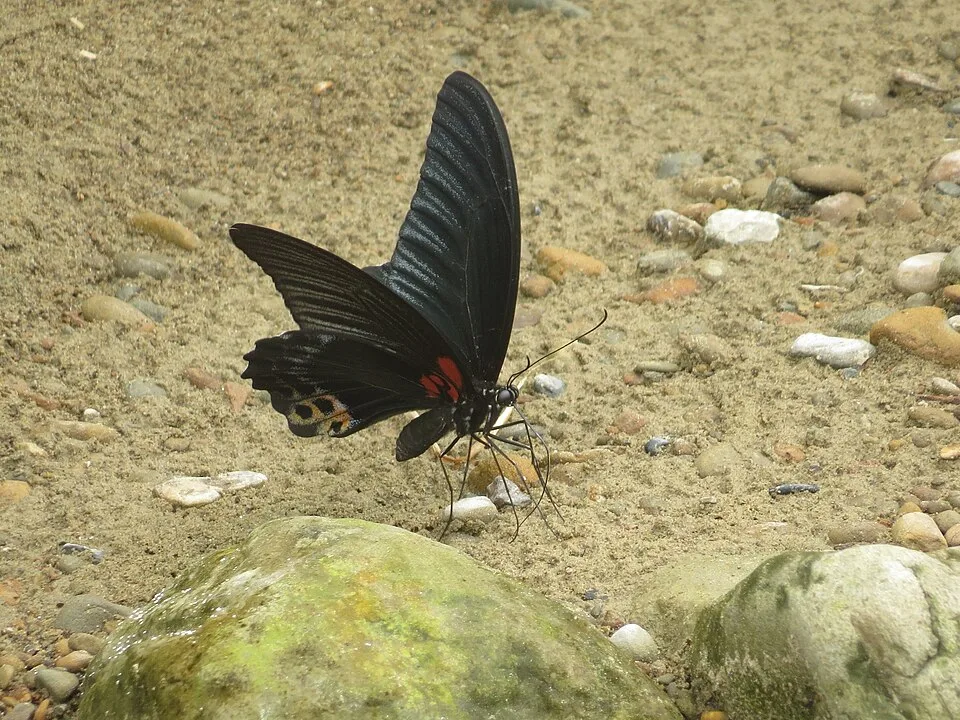
Male and female appearance differs, and females occur in mimetic and non-mimetic forms. In studied populations, mimetic females combine particular hindwing colours, tails and abdominal colour to resemble unpalatable swallowtails. This is Batesian mimicry: an edible butterfly gains protection by resembling a less palatable one. Pattern alone should be assessed alongside locality and regional identification references.
Sources & references · 1
Frontiers in Insect Science · doublesex controls hindwing and abdominal mimicry traits in Papilio memnon (2022)Habitat and Borneo range
A Bungo Range survey lists Papilio memnon memnon in Sarawak and includes a photograph. A Sabah Forestry survey also recorded it at Mokotog near Keningau. These independent records establish occurrence on Borneo. They should not be confused with captive butterfly-house records or with changing classifications of the similarly named lowii taxon.
Sources & references · 2
Universiti Malaysia Sarawak · Butterflies of Bungo Range: checklist and Papilio memnon photographSabah Forestry Department technical report · Kepelbagaian Serangga di Kg. Mokotog, Sook, Keningau, Sabah (2015)Reproduction
Breeding experiments show that alternative female forms are inherited through a region involving the doublesex gene. The female pattern is not simply a response to the flower she visits. Controlled crosses also followed caterpillars, pupae and emerging adults; growth and final body size differed between sexes. The experiments explain development, while local Bornean breeding seasons remain unestablished.
Sources & references · 2
Frontiers in Insect Science · doublesex controls hindwing and abdominal mimicry traits in Papilio memnon (2022)Journal of Insect Physiology · Development and adult traits among Papilio memnon mimicry genotypes (2018)Food and ecological role
Caterpillars have been reared on several Citrus species in Indonesian research. A food plant supplies leaves throughout the growing larval stage, whereas the flying adult uses flowers. The caterpillar also possesses an eversible scent gland behind the head, the osmeterium; chemical studies of this species show that its secretion changes during larval development.