Recognition
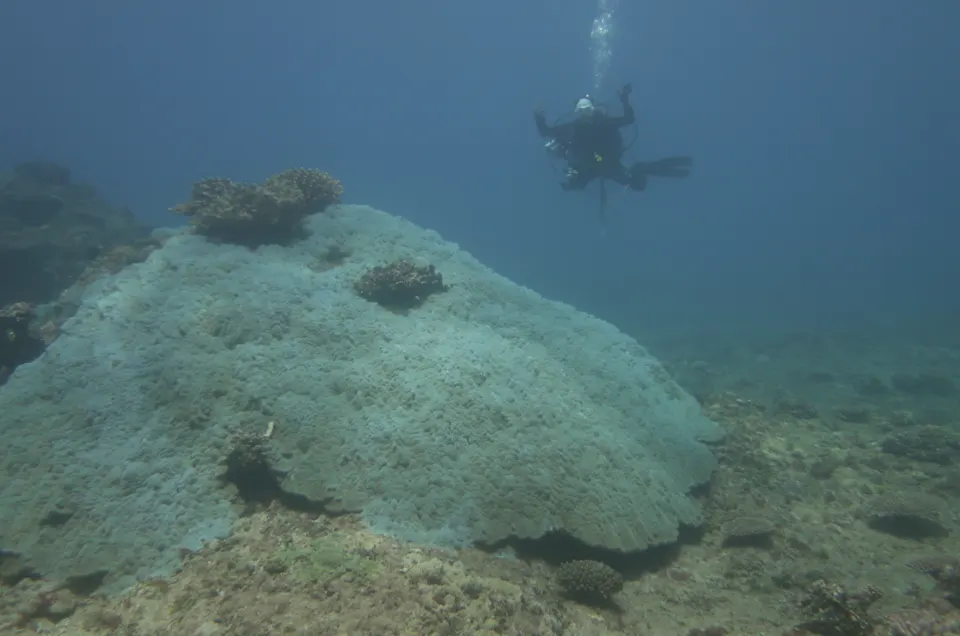
Colonies can resemble rounded domes or helmets, often cream or yellow. Intertidal colonies may develop a microatoll form, with growth shaped by the level at which exposure limits the upper surface. Similar massive Porites can look alike; tiny skeletal structures around individual polyps are more useful for secure species identification than colony colour alone. The large visible mound is a living colony, not one enormous animal.
Sources & references · 2
Corals of the World · Porites lutea species factsheetSpecies account or primary research · Corals of the World: coral taxonomy overviewHabitat and Borneo range
The species occurs in lagoons, back reefs and fringing reefs. Studies document it at Bontang Kuala in East Kalimantan and at Marabatuan and Matasirih in South Kalimantan. At Bontang, measured skeletal extension averaged roughly 0.8–1.2 centimetres per year in the sampled colonies. Dense and less dense bands, together with fluorescent marks, helped researchers examine growth and the influence of runoff.
Sources & references · 3
Corals of the World · Porites lutea species factsheetJournal of Coastal Development Universitas Diponegoro · Growth rates of massive coral Porites lutea in BontangIndonesian Journal of Marine Sciences Universitas Diponegoro · Hard coral community structure Marabatuan and MatasirihFood and ecological role
Nutrition combines energy from photosynthetic symbionts with particles captured by the polyps. Light and moving water therefore influence different routes by which the colony obtains food. Experimental work on this species examined how changing water conditions affect both photosynthesis and prey capture. Its appearance as a solid mound hides thousands of small feeding surfaces interacting with the surrounding seawater.
Sources & references · 1
Species account or primary research · Porites lutea nutrition under internal waves (2013)Reproduction
A Ningaloo study found predominantly separate male and female colonies. Eggs and sperm are released into the water for external fertilization. This broadcast spawning links separate colonies through the surrounding sea; its timing differs between regions, so the Australian study supplies a reproductive mechanism rather than a Bornean spawning calendar.