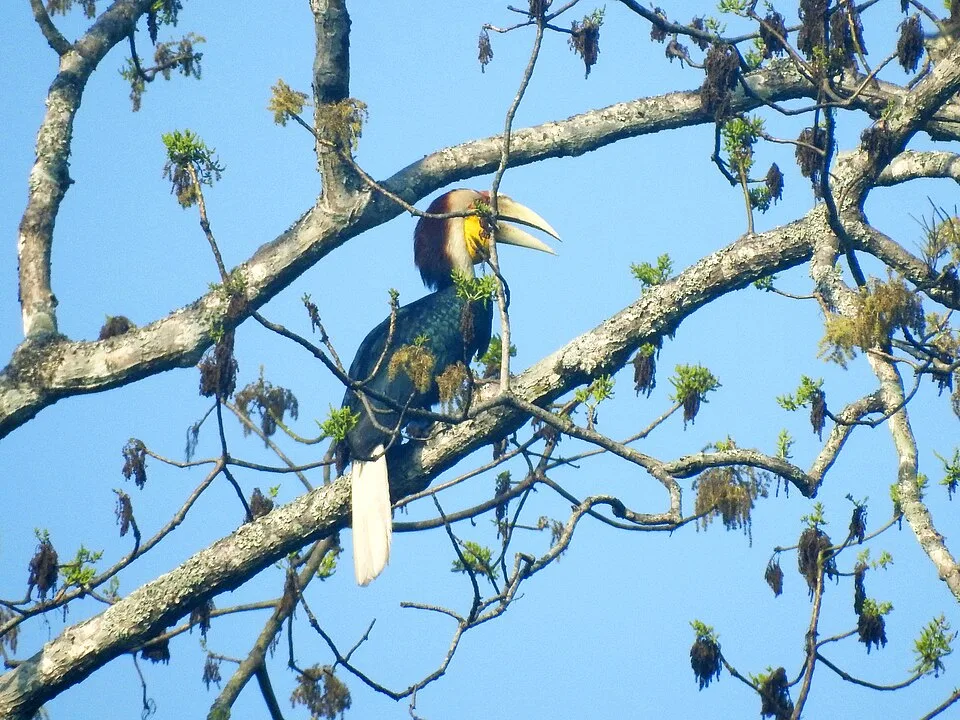
Ridged bill and coloured throat
This large hornbill has a pale bill with ridges and a relatively low casque. A dark band crosses the throat pouch: yellow in the male, blue in the female. Young birds initially resemble males. Low grunts and the sound of wingbeats can announce a passing bird before it clears the tree crowns.
Sources & references · 2
IUCN SSC Hornbill Specialist Group · Wreathed Hornbill accountARTIS Amsterdam Royal Zoo · Gewone jaarvogelTravelling between fruit trees
It feeds mainly high in the forest, taking figs and other fruits as their crops change with season and location. Some animal food supplements this diet. Birds can travel far between fruiting trees and gather at communal evening roosts. Extensive forest therefore matters beyond a single nest tree: feeding and resting places may lie in different parts of the landscape.
Sources & references · 1
IUCN SSC Hornbill Specialist Group · Wreathed Hornbill accountThe male supplies a sealed nest
A female nests inside a hollow tree with most of the entrance sealed, receiving food from the male through a slit. Nest cavities were documented in Kapuas Hulu; a separate Tabin observation recorded a male feeding his enclosed partner high in a Koompassia excelsa tree. The species is globally Vulnerable. Large surviving trees are valuable even in selectively logged forest. The female and chick can remain enclosed for around three months. Sometimes she leaves earlier and joins the male in supplying food to the young. This variation shows how food delivery can change as the nesting cycle proceeds.